

Luxury watch battery replacement
Luxury watch battery replacement.
Specialist battery replacement and careful checks for your luxury quartz timepiece.
“Thank you for bringing my watch back to life, it feels new again!”
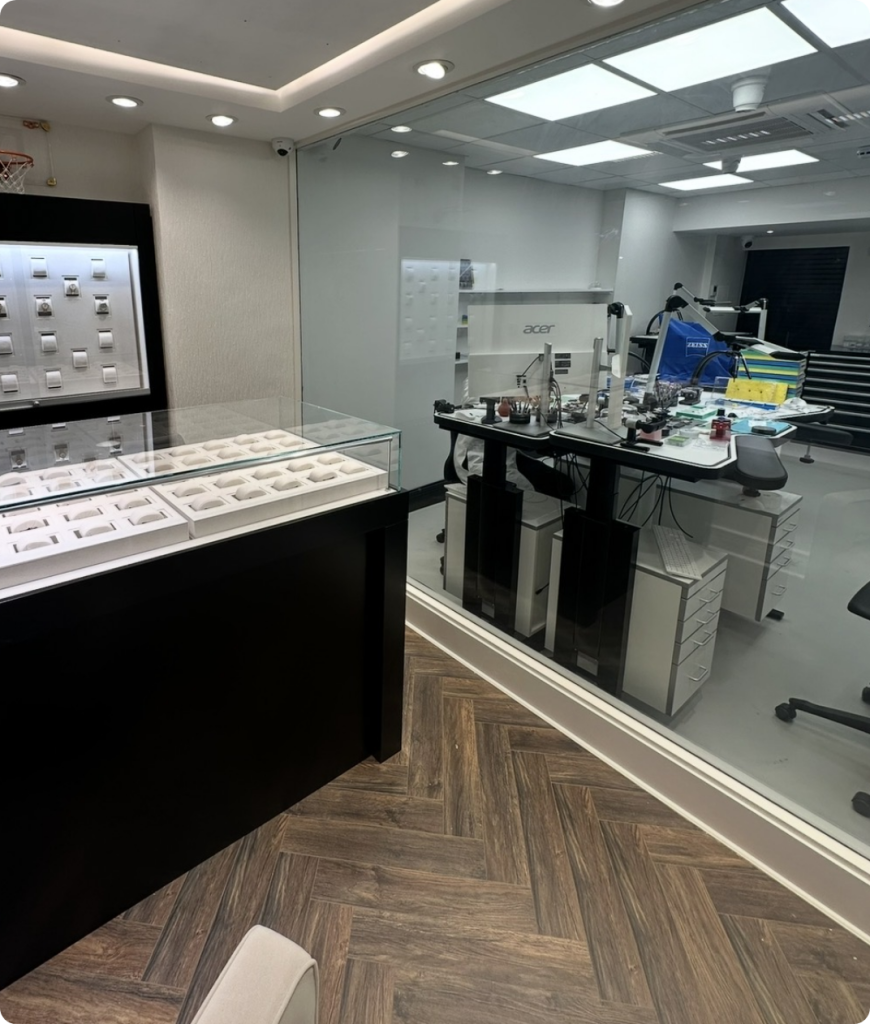
Our Hatton Garden workshop
More than a change of battery.
The team assesses your quartz watch and advises on the appropriate replacement and any further checks.
- Inspect the watch and discuss the symptoms
- Select the appropriate battery
- Replace it with careful handling
- Check operation and advise on seals
- Discuss any further testing required
Luxury watch battery replacement
Talk to a watchmaker.
Tell us about your watch. We’ll email you with the next step.
Care without the guesswork.
Founder-led expertise
25 years of watchmaking experience, applied to the assessment of your watch.
Explore our workshopA clear next step
Discuss the proposed work and estimate before deciding how to proceed.
Make an enquiryFrom enquiry to workshop
Personal care. Clear next steps.
-
Your watch
Share the model, symptoms and any service history you know.
-
Your assessment
Understand the proposed work and estimate before deciding.
-
Care & final checks
Agreed work is followed by checks suited to your watch.
Before you
entrust it to us.
Not sure what your watch needs? Speak with our watchmakers about the next step.
Ask our watchmakersWhat will a battery replacement cost?
Costs depend on the watch and work required. Following an assessment, the team explains the estimate so you can decide how to proceed.
How long will it take?
The condition, complexity and availability of parts affect timing. An estimated completion time is provided after inspection.
Is water resistance checked after a battery change?
Water resistance should not be assumed after opening the case. Ask about seal inspection and appropriate pressure testing for your watch's design and condition.
What should I include in my enquiry?
Include the brand and model if known, when the watch stopped and when its battery was last changed. If you do not have those details, describe the issue in your own words.
Is my enquiry a confirmed booking?
Not yet. This form starts a conversation about your watch. Please wait for the team to confirm the next step and agree a time with you before treating it as an appointment.
Find the workshop.
Open Google MapsWatch battery replacement for quartz watches you value
For many quartz watches, a watch battery replacement is the main reason the case is ever opened, and for a good watch it deserves the same care as any other job at the bench. Opening the case disturbs the seal that keeps water and dust out. The wrong battery, or a careless hand with a metal tool, can harm a circuit that costs far more to put right than the battery itself.
This page explains how to tell whether your watch needs a new battery or something else, why a dead battery should not be left in the case, what a careful watch battery replacement involves, and why it is not the same thing as a service. It also sets out how the work is handled at our Hatton Garden workshop.
Signs your watch needs a watch battery replacement
The obvious sign is a watch that has stopped. There are often earlier warnings, and spotting them gives you time to arrange the work before the battery is completely flat:
- The seconds hand jumps in steps of several seconds. Many quartz movements do this on purpose as an end-of-life warning, so you know the battery is running low.
- The watch loses time or stops and starts, particularly in the cold.
- Extra functions fail first. A chronograph, alarm, backlight or digital display may stop working or fade before the hands do.
If the watch stops again soon after its last battery change, the battery may not be the problem. A movement fault, a sticky gear train, damaged contacts or moisture can all drain a battery quickly or stop the hands. In that case the watch needs diagnosing rather than another new cell.
Quartz or mechanical: does your watch have a battery?
Not every watch that stops needs a watch battery replacement, so it helps to know what is inside. A quartz watch uses a battery to power a small circuit. The circuit makes a tiny quartz crystal vibrate at a very steady frequency, counts those vibrations, and sends a pulse to a stepping motor that moves the hands. That is why most analogue quartz watches tick once a second.
A mechanical watch has no battery at all. It is powered by a coiled mainspring, wound either by turning the crown or, in an automatic, by a weighted rotor that winds the spring as you move. If a mechanical watch stops, try winding it or wearing it for a while. If it still stops, runs fast or slow, or will not hold its power, it needs a watchmaker’s attention rather than a battery.
Some watches sit between the two. Light-powered and motion-powered quartz watches store energy in a rechargeable cell or capacitor rather than a standard battery. When those stop holding a charge, the fix is different from a routine watch battery replacement, so mention the type of watch when you enquire.
Why a dead battery should not stay in the case
Most analogue quartz watches run on small silver-oxide button cells. When a cell is exhausted and left in the watch, it can eventually leak. The electrolyte inside is corrosive, and it can creep onto the battery clamp, the contacts and the circuit board around it. Green or white crust around the battery is a sign that this has already started.
Leakage can turn a simple watch battery replacement into a movement repair, because corroded contacts and circuits may need cleaning or replacing before the watch will run reliably again. The sensible habits are to replace a flat battery promptly, and to ask for the battery to be taken out if you plan to put a quartz watch away unused for a long time.

What a careful watch battery replacement involves
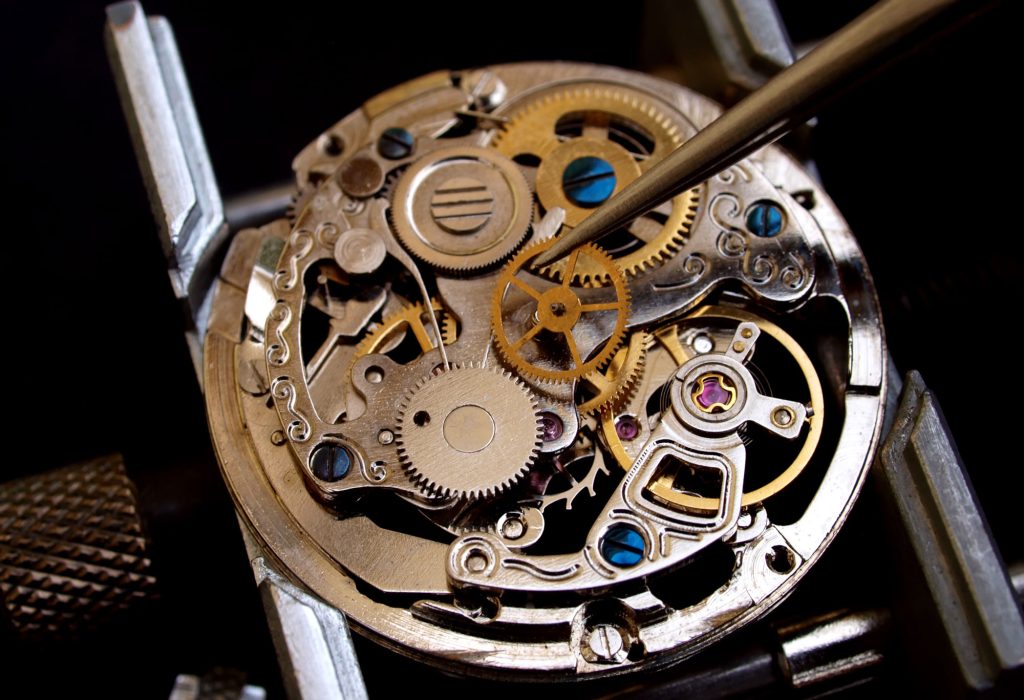
The first job is to identify how the case opens. Some case backs screw down and need a case wrench that grips the notches without slipping. Others snap on and are opened with a blade at a specific lift point. Some are held by small screws, and some watches have a one-piece case that opens from the front, through the glass and bezel. Using the wrong method is how case backs get gouged and bezels get bent.
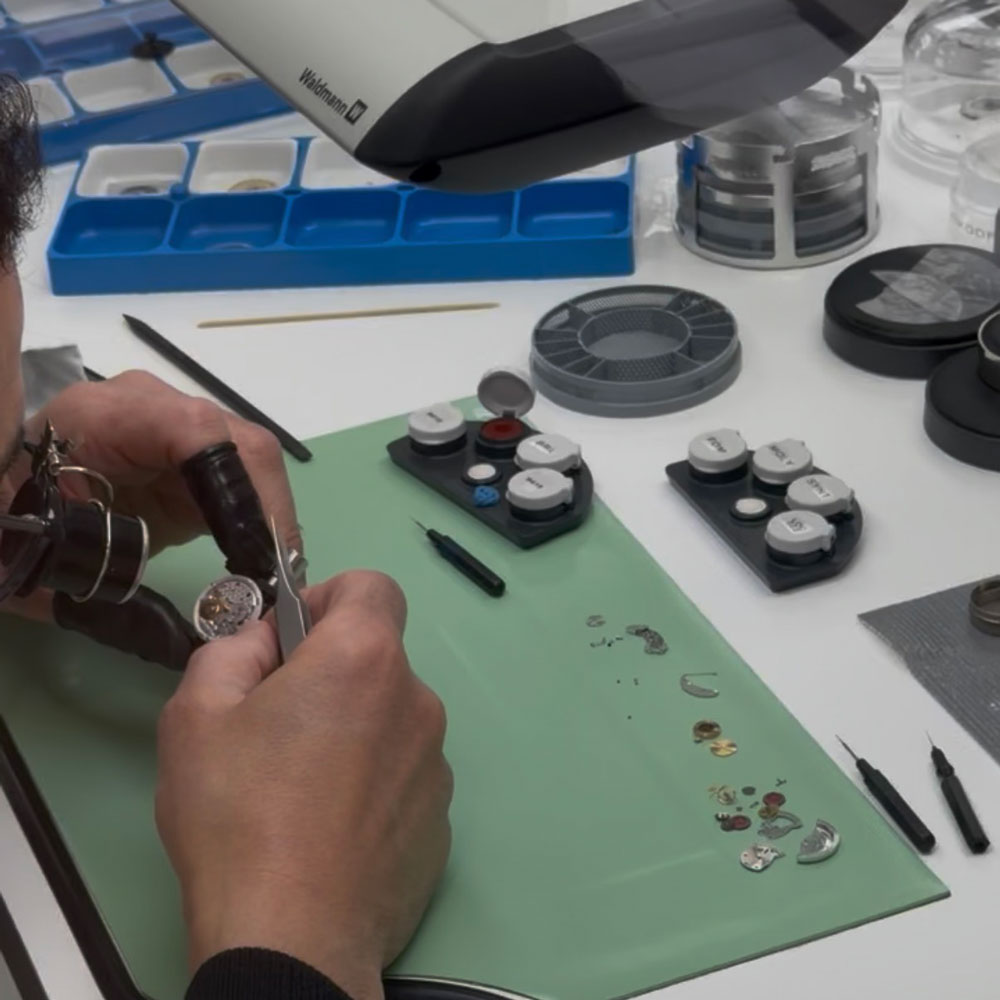
With the case open, the old battery is removed with non-metallic tweezers so it cannot short across the circuit. The battery compartment and contacts are checked for corrosion, and the movement for moisture or dust. The replacement is chosen to match the size and type the movement was designed for, because a cell that is the wrong thickness or chemistry can fail early or sit poorly in its clamp. Some watches, including many quartz chronographs, then need a reset so the hands line up with zero.
Closing the case is as much a part of a watch battery replacement as opening it. The case back gasket is inspected, because each time the watch is opened that seal is compressed, moved and exposed to dust. A gasket that has gone flat, hard or cracked will not seal properly however tightly the back is closed. Where needed, the gasket is replaced before the case back goes on.
Water resistance after a watch battery replacement
A watch that was water resistant before its battery was changed should not be assumed to be water resistant afterwards. The only way to know whether the case is sealing on the day is to test it. Where the watch’s design and condition allow, a pressure test does that.
It is worth being clear about what that test can tell you. It checks the case at the time of testing, and the pressure used may differ from the depth or pressure rating printed on the watch. It is not a lifetime promise. Gaskets keep ageing between battery changes, and a crown left pulled out, or a knock to the case, can let water in long after a successful test. If you swim or shower with your watch, keep that in mind.
A watch battery replacement is not a service
A new battery restores power. It does nothing for the rest of the movement. Quartz movements still have a gear train, pivots and small amounts of oil, and over the years that oil thickens and parts wear. A watch with tired lubrication draws more current from its battery, so a cell that should last a good while may run flat early.
At Alpha Group, a watch battery replacement on its own is a limited repair, not a complete service, and the approved quotation records exactly what is included. If the watch shows signs that it needs more, such as a battery running down unusually quickly, erratic timekeeping or corrosion, the team explains what further work is advisable. Our servicing and repairs page describes what a full service covers, and a watch health check is a way to find out where the watch stands before you decide.
How a watch battery replacement works at Alpha Group
Tell us about the watch and anything you want handled in a particular way, such as preserving an engraved case back or keeping original parts. You can book a consultation or use our contact page. The watch is assessed before any work, and you are told what is proposed with a quotation or an estimate, including whether the price is fixed or an estimate. Work starts only once you have approved it.
If the watch is new enough to be under a manufacturer’s warranty, check its terms before booking. Independent repair work may affect a manufacturer’s commercial warranty. If Alpha Group’s work carries a warranty, its length and what it covers are set out on the approved quotation, then confirmed on your invoice or service record.
When the work is finished, payment is due before collection or dispatch. To collect, bring your invoice or booking receipt. Alpha Group sends a collection verification email and may ask for photo ID, which keeps your watch going back to the right person.
Looking after a quartz watch between batteries
A few habits help the new battery and the seals do their job until the next watch battery replacement is due:
- Keep it away from strong magnets. Speakers, magnetic clasps on bags and some phone cases can interfere with a quartz watch’s stepping motor while they are close. Our guide to the causes of watch magnetisation lists common causes and how to avoid them.
- Avoid extremes of temperature. Batteries perform poorly in strong cold and age faster in heat, so a watch left on a sunny windowsill or in a freezing car has a harder life.
- Use the crown as the manufacturer instructs. Make sure it is fully pushed in or screwed down after setting, and leave the crown and any pushers alone in water unless the manufacturer says otherwise.
- Do not leave a stopped watch for months. A flat battery is the one most likely to leak, so book the watch battery replacement when it stops rather than when it is convenient.
What to ask before any watch battery replacement
Wherever you take a watch you care about, a few questions tell you a lot about how it will be treated. They are worth asking us, too:
- Will the case back seal be inspected, and replaced if it is flattened or cracked?
- Can the watch be pressure tested after the case is closed, and will you explain what the result means?
- Will you tell me if you find corrosion, moisture or another fault, before doing anything about it?
- What exactly is included? A watch battery replacement is a limited repair, so it helps to know where it stops and a service begins.
- How will the case back be protected if it carries an engraving, a display window or a finish you want kept as it is?
Clear answers to those questions are a better guide to quality than speed. A rushed watch battery replacement on a counter can leave a watch running but no longer sealed, and that only shows up the first time it meets water.
Visiting the workshop
You will find us at 9 St Cross Street, Hatton Garden, London EC1N 8UB. Farringdon and Chancery Lane stations are a short walk away. The workshop is open Monday to Friday from 10:30 to 17:30 and closed at weekends, so plan a weekday visit for your watch battery replacement, or call 020 4531 5299 to arrange one. You can also message us on WhatsApp at +44 7726 776776.
If you would rather send your watch, choose suitable packaging and a carrier whose insurance covers its value. Charges and insurance for the return journey are confirmed before it is dispatched. In the same building is our sister business, Kings & Queens Watches, which deals in pre-owned luxury watches.
Watch battery replacement FAQs
Why is my seconds hand jumping every few seconds?
On many quartz watches this is a built-in low-battery warning. The watch is still telling the time, but the battery is close to the end of its life. Arrange a watch battery replacement soon, before the cell runs completely flat.
My watch stopped again shortly after a new battery. Why?
It could be a faulty or unsuitable battery, but more often it points to the movement: old lubrication, dirt, a damaged coil or circuit, or corrosion from an earlier leak. The watch needs checking to find the cause.
Does an automatic watch need a battery?
No. An automatic is a mechanical watch wound by the movement of your wrist. If it stops while you are wearing it regularly, it may need a service, which the team can assess.
How often will my watch need a watch battery replacement?
It depends on the movement, the size of the battery and the functions you use. A chronograph left running, a backlight or an alarm all draw extra power. If the gap between battery changes suddenly gets shorter, that is worth investigating rather than ignoring.
Can I change the battery myself?
On an inexpensive watch, perhaps. On a watch you value, the risks are a scratched or dented case back, a damaged gasket, a short across the circuit or a case that no longer seals. A professional watch battery replacement avoids those risks and gives the seals a proper check.
Should I remove the battery if I am storing the watch?
If the watch will sit unused for a long period, it is sensible to have the battery removed so it cannot leak inside the case. Tell the team you plan to store it, and a fresh battery can go in when you want to wear it again.
Will my chronograph hands line up after the battery change?
Some quartz chronographs lose track of the hand positions when the power is cut and need resetting to zero afterwards. This is checked as part of the work, so the hands return to zero properly when you reset the chronograph.